Paid tasks: the missions that actually pay
"Paid tasks": behind the term, there is a real, fast-growing market (AI annotation, moderation, LinkedIn engagement, app testing) and many well-packaged scams. This pillar guide ranks the 8 mission families by real hourly value, gives honest €/h ranges, and explains why the Microtaches model (Ops, shop, DAC7) changes the game in France.
What exactly is a paid task?
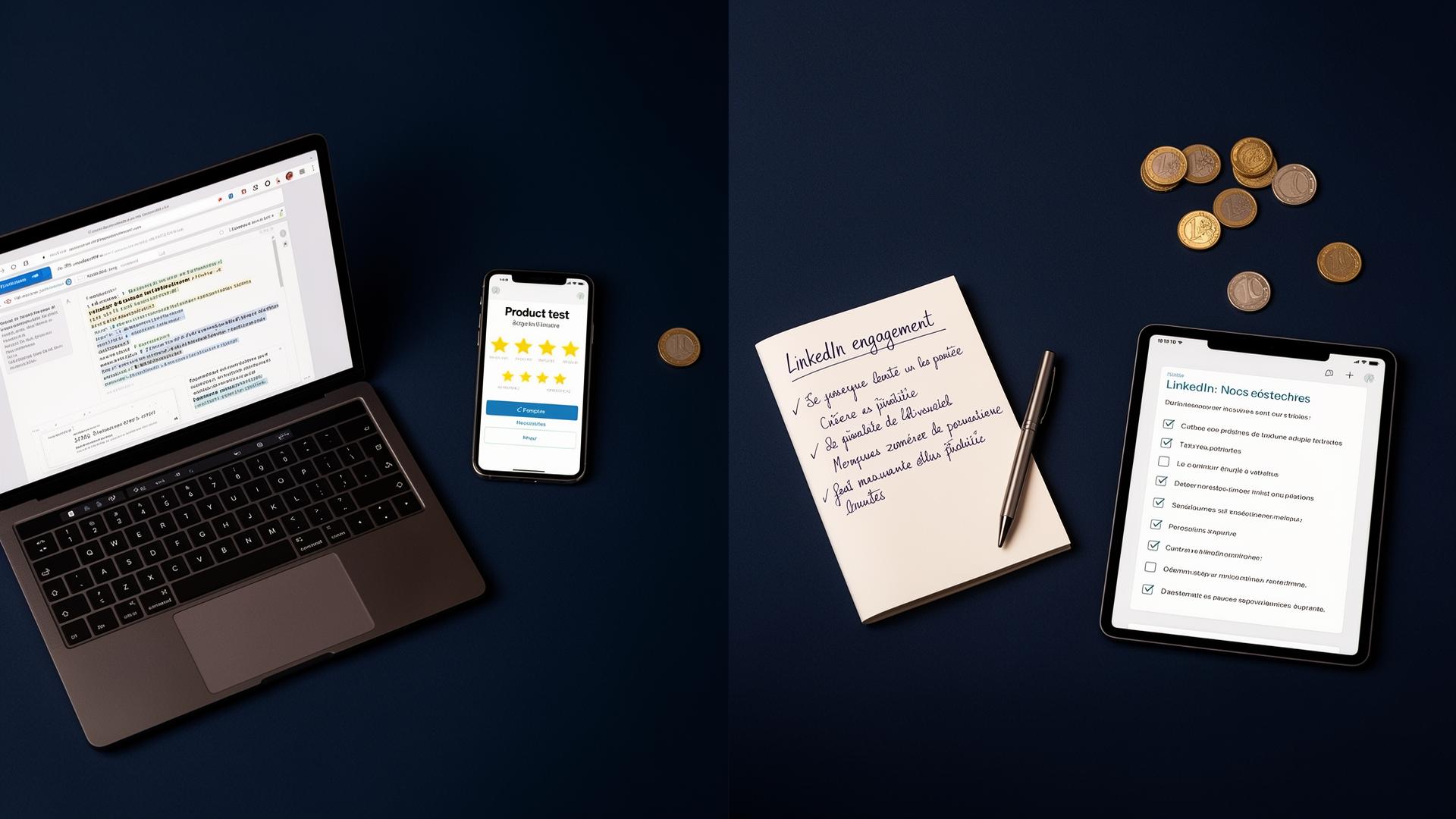
A paid task (or micro-task) is a short unit of digital work — seconds to tens of minutes — handed by a company to a human via a platform. You're asked to do something a machine can't do alone: judge the quality of an AI answer, check that an app works on your phone, post an authentic LinkedIn comment, moderate an ambiguous remark.
Not to be confused with: regular opinion surveys (often poorly paid), dropshipping or "miracle trading" (not work but resale or speculation), and fake Telegram "missions" demanding a deposit before paying (pure scams).
Why the market is booming in France
- Generative AI boom. Mistral, LightOn, Kyutai and competitors need millions of French annotations to train and correct their models.
- Moderation imposed by the DSA (Digital Services Act). Platforms must moderate more, faster, in local languages.
- LinkedIn engagement crisis. Brands want authentic human engagement to counter distrust of bots.
- Digital sovereignty. Many European vendors prefer FR/EU contributors for GDPR, linguistic quality and cultural reasons.
The 8 mission families that actually pay
Here is a complete market overview, sorted by real hourly value (low to high) and accessibility (boxes to tick to get started).
1. Data entry & verification — ~€3-5/h
Copying information from images, deduplicating product sheets, checking opening hours. Very accessible, very time-consuming, poorly paid. Useful to start and hit a first withdrawal threshold, not interesting long-term.
2. Serious surveys — ~€4-7/h
Trusted panels: BVA Mon Opinion Compte, Bilendi & Respondi, Toluna Influencers. Provided you answer honestly and avoid the "miracle panels" that pay nothing. Good complement, never a main income.
3. AI text annotation — ~€5-7/h
You're shown a short text and tick labels (sentiment, topic, toxicity, compliance). Entry-level AI training, open to any careful French speaker. Continuous demand, recurring missions.
4. App & product testing — ~€6-10/h
You install an app or use a product and submit a structured review (screenshots, journey, feel). Far more profitable when the vendor wants real qualitative feedback than when they hand out "gift kits" in exchange for a 5-star rating (avoid).
5. Qualified LinkedIn engagement — ~€8-15/h
Nominal comments on B2B posts, under your name, in your area of expertise. Nothing to do with engagement pods (banned by LinkedIn). Well paid because a credible human signed comment has become rare.
6. RLHF ranking & AI quality control — ~€7-12/h
You're shown two AI-generated answers and pick the better one, or rate each on several criteria. Better paid than plain annotation because you must compare, justify and stay consistent across hundreds of items.
7. UX testing & manual validation — ~€10-18/h
You test a user journey (signup, checkout, subscription) and precisely describe frictions. Demanded by SaaS and e-commerce vendors. Requires method and clear writing.
8. Content moderation — ~€10-20/h
Approving or rejecting comments, photos, videos against a strict policy. Better paid than annotation because it demands rigor and emotional stability. Exists as one-off missions or long-term assignments for vendors and platforms.
How much do you really earn? (by family)
| €/h | |
|---|---|
| Data entry & verification | ~€4/h |
| Serious surveys | ~€6/h |
| AI annotation (simple) | ~€6/h |
| App & product testing | ~€8/h |
| Qualified LinkedIn engagement | ~€12/h |
| RLHF ranking | ~€10/h |
| UX testing | ~€14/h |
| Content moderation | ~€16/h |
Missions to avoid vs missions to prefer
| Missions to avoid | Missions to prefer | |
|---|---|---|
| Conditions transparency | Vague, changed after the fact | Rate, duration and criteria shown before acceptance |
| Payment method | Crypto, Steam top-ups, money orders | Platform currency convertible to € (Ops, SB…) |
| Deposit requested | Yes ("starter kit") | Never |
| KYC | None even past €1,000 | Required from a clear threshold |
| Annual cap | Missing or opaque | Stated (e.g. €2,500/year on Microtaches) |
| DAC7 compliance | Opaque or non-cooperative platform | Compliant, reporting platform |
| Earnings promise | "€200/day with no effort" | Verifiable €/h ranges |
| Support | None or Telegram | Identifiable French team |
Practical grid to tell a healthy mission from a shady one.
How much you really earn, by profile
Real income depends much more on available time and discipline than on the "secret" of this or that platform. Three typical profiles observed on the French market in 2026:
- Student or worker on the side (3 to 5 h/week): €40 to €120/month, mostly via AI annotation + app testing + surveys.
- Stay-at-home parent or freelancer (1 to 2 h/day): €150 to €400/month, combining 2-3 platforms and skilling up on RLHF and UX testing.
- Expert profile (LinkedIn, moderation, languages): occasional but well paid: €300 to €800/month on targeted missions, provided you've built internal reputation (ratings, badges, reliability).
The Microtaches model: why it's different
Microtaches is the French entity in this market. Three things set it apart from the historical Anglo-American platforms (Clickworker, Swagbucks, Microworkers):
- An internal currency, Ops. 1 Ops = €0.0082 in shop (Amazon, Netflix, Spotify, Apple, Steam cards, physical products) — but €0.0042 via bank withdrawal (IBAN). That's approx. ×1.95 in value if you use the shop.
- Clear and transparent rules. Mandatory KYC from a 1,000 Ops balance, internal annual cap of €2,500/year/user, and compliance with DAC7 reporting obligations.
- A 10,000 Ops inalienable reserve. It stays permanently on your account and is non-withdrawable. Only the surplus earned above this reserve can be cashed out (from 5,000 withdrawable Ops).
For the full economics, read our Ops → € → gift cards conversion guide and our €2,500/year cap explainer.
How to get started in 4 steps
- 1. Free signup on a compliant platform. No deposit, no "paid training".
- 2. Demographic wizard. The more complete your profile, the more targeted and better-paid missions you'll receive.
- 3. First low-barrier missions. Simple annotation, short surveys, app tests. Goal: build a reliability history (validation rate > 95%).
- 4. Verification and progression. Once a 1,000 Ops balance is reached, complete KYC verification to unlock the shop and prepare for future payouts.
Withdrawal methods on Microtaches
Your Ops can be withdrawn to a bank account, a mobile money account or an online wallet. Bank transfer is available from the usual minimum; MVola, Orange Money, Wave, MTN MoMo, PayPal, Skrill and Neteller are available from 25,000 Ops; Revolut and Crypto are coming soon.
| Type | Availability | Where it is used | |
|---|---|---|---|
| Bank transfer (IBAN) | Bank | Available from the usual minimum | Bank account with an IBAN, in Europe or elsewhere (fixed fee outside Europe) |
| MVola | Mobile money | Available from 25,000 Ops | Madagascar |
| Orange Money | Mobile money | Available from 25,000 Ops | Madagascar, Ivory Coast, Senegal, Cameroon, Mali, Burkina Faso, Guinea, DR Congo… |
| Wave | Mobile money | Available from 25,000 Ops | Senegal, Ivory Coast, Mali, Burkina Faso… |
| MTN MoMo | Mobile money | Available from 25,000 Ops | Ivory Coast, Cameroon, Benin, Guinea, Congo, Ghana… |
| PayPal | Online wallet | Available from 25,000 Ops | Countries where PayPal lets you receive money |
| Skrill | Online wallet | Available from 25,000 Ops | International online wallet |
| Neteller | Online wallet | Available from 25,000 Ops | International online wallet |
| Revolut | Neobank | Coming soon (no date yet) | Coming soon |
| Crypto | Cryptocurrency | Coming soon (no date yet) | Coming soon |
Methods shown on the Withdrawals page of your Microtaches account. Countries listed are examples where the service is common.
Frequently asked questions
- How much can you realistically earn per month with paid tasks?
- Between €40 and €800 per month depending on time invested, profile and platform mix. An active side gig (1 to 2 h/day) typically lands at €150-€400/month. Any promise beyond €1,500/month "without effort" is a lie.
- Do you need a diploma or technical skills?
- No, for the vast majority of missions (annotation, surveys, testing, moderation). Strong written French and critical thinking are enough. Technical missions (code correction, advanced red-teaming) are the exception and a small share of the market.
- Is the income reportable to tax authorities?
- Yes, from the first euro. European platforms automatically report personal services income under the DAC7 directive, without the €2,000 goods-selling threshold. See our complete tax guide.
- Are my data and answers anonymous?
- On serious platforms, your contributions are stored under an internal ID and used in aggregate. Your name is never publicly tied to an annotation or technical comment. Exception: qualified LinkedIn engagement missions, which are by design under your real name.
- Is there an income cap?
- On Microtaches: an internal cap of €2,500 per year per user across all shop orders and payouts. On other platforms, policies vary, but income must be reported to tax authorities from the very first euro.
- Can you combine several platforms?
- Yes, it's even recommended to smooth out dry spells and access varied missions. Just remember to aggregate your annual income for tax reporting.
- Is this legal in France?
- Completely legal as long as you report your income and the platform complies with DAC7. Paid tasks generally fall under Non-Commercial Profit (BNC) or micro-BNC, depending on your status.
- How long does it take to receive your earnings on Microtaches?
- Orders placed in the shop are fulfilled within up to 2 weeks, while bank transfer payout requests take up to 3 weeks. Identity verification (KYC), unlocked once your balance reaches 1,000 Ops, takes up to 7 business days.
- What is the purpose of the 10,000 Ops inalienable reserve?
- No, this reserve cannot be cashed out: it is an internal platform rule that keeps 10,000 Ops permanently on your profile. Only Ops earned above this reserve threshold are withdrawable, starting from a minimum of 5,000 withdrawable Ops.
Go deeper with the specialized guides of this cluster: training French AI (RLHF), authentic LinkedIn engagement, paid product testing, become a virtual assistant and manual validation & quality.
Specific micro-task missions
All articles in this hub
- Earning money watching ads: myth or reality?"€50 a day watching ads" — the promise has been circulating for 15 years. The actual numbers tell a very different story. Here is what video-ad-viewing platforms (PTC, mobile apps, browser extensions) really pay, why payout thresholds are deliberately rigged, and the rational alternative of short micro-tasks.
- Earn money by testing mobile applications"Get paid €200 to test an app": this clickbait sells dreams, the reality is more nuanced. Here are the 2 serious paths to earn money by testing mobile applications, real ranges, and why micro-missions are often more accessible than long UX sessions.
- Earn money on social networks through micro-missionsNo 10,000-follower audience? Good news: paid social micro-missions are open to any authentic account. Here are the 6 mission types that actually pay, what's forbidden, and how much to expect per hour.
- Paid-to-click missions: real earnings and serious alternatives"Paid-to-click missions" still evokes the old PTC sites where a click is worth €0.001. The reality is more nuanced: some qualified clicks (LinkedIn engagement, AI rating, product voting) pay decently, others pay nothing anymore. Here is the honest 2026 map, with realistic orders of magnitude and traps to avoid.
- Content Moderator Jobs: Real Work, Pay, Risks, and EmployersContent moderator jobs can mean enforcing platform rules under tight deadlines, not simply browsing online from home. This guide separates public US pay estimates from actual offers, explains mental health risks and legal protections, and helps you compare employers with flexible alternatives.
- Paid surveys with PayPal: how to choose a reliable siteCompare survey sites that pay using official payout information and country checks. See how legit survey sites handle rewards before spending time on paid surveys.
- Getting paid to comment on LinkedIn: what's actually allowedA paid human comment can be perfectly legal. A paid comment dressed up as spontaneous can become deceptive. Here's the line you can't cross, and how LinkedIn commenting missions can be done seriously.
- Become a Product Tester: How It Works and What It Really PaysTo become a product tester can mean getting a free face cream, being paid to test a website, or taking part in research studies. This guide separates those three formats, shows the amounts and payment delays the platforms publish, and helps you spot fake offers.
- What Are Micro-Tasks? Definition, Real Examples and How You Get PaidSo, what are micro-tasks? They are small online jobs, short and guided by instructions, paid per unit once your work has been checked. This guide covers the definition, where micro-work comes from, real industry examples, how micro-tasks differ from surveys and freelancing, and how you actually get paid, limits included.
- Data Annotation Jobs: What They Are, Who Hires and How to StartData annotation jobs, also called data labeling or AI training jobs, are real, remote and sometimes well paid. They are also selective, and access depends heavily on your country. This guide covers who hires, what each company publishes about pay and payment, how to pass assessments and how to avoid the task scams the FTC warns about.
- Search engine evaluator jobs: what the work is, who hires and how to applySearch engine evaluator jobs pay you to judge whether search results answer what people are looking for. This guide covers the real tasks, the companies that hire, the published hourly rates, the residency rules and the qualification exam. It also covers what to do if you are not eligible.
- AI Training Jobs: A Realistic Guide to Pay, Tests and Remote WorkRemote AI training jobs range from response evaluation and data labeling to specialist projects, but an advertised rate is not a reliable paycheck. This guide compares platforms, explains entry tests and country restrictions, and shows how to check payment terms and avoid fake recruiters.
- Mystery shopping: how it works and what it really paysA mystery shopping assignment involves following a scenario, observing a customer experience, and submitting a detailed report. Learn how to assess published pay, separate reimbursements from earnings, understand the rules in France, and spot fake recruiters before you commit.
- Data entry jobs from home: real work versus scamsReal data entry jobs from home exist, but an advert is not proof of employment or earnings. Compare hiring channels, published fees and scam signals before you start.
- Transcription jobs from home: a complete beginner’s guideTranscription jobs from home generally pay for recording duration, not your working time. Compare official rates, assessments and application limits before deciding where to apply.
- Become a video game tester: QA jobs, pay and realityBecome a video game tester by understanding the difference between QA jobs, research playtests and free betas. Explore verified pay references and build a realistic application.
- Online translation jobs: a practical beginner guideOnline translation jobs cover different services with different responsibilities. Compare verified application routes, professional rate benchmarks and practical precautions.
- Paid website tester: platforms, pay and selectionA paid website tester explains how a digital experience feels, but invitations are irregular. Compare nine services, payment rules and practical preparation before applying.
- Paid surveys Belgium: panels, rewards and payment checksPaid surveys Belgium can bring occasional rewards, not guaranteed wages. Compare confirmed rules, local payment checks and a practical way to protect your time.
- How to become a beta tester: access, work and payLearn how to become a beta tester without confusing early access with paid work. Compare official programmes, reporting methods and the real time involved.
- UHRS jobs: access, qualifications and payment explainedUHRS jobs require an authorised partner, not just a Microsoft account. Learn how access, qualification, balances and actual payment differ.
- How to become an AI trainer: skills, tasks and payWondering how to become an AI trainer? Understand the work, compare published requirements and pay, and check the practical limits before applying.
- Mystery shopper Belgium: companies, pay and scamsMystery shopper Belgium: companies, expenses and payments to check before a visit. A practical guide to avoiding scams without confusing reimbursement with income.
- Prompt engineering jobs: skills, access and realistic first stepsPrompt engineering jobs require more than clever instructions. Learn how to demonstrate evaluation skills, check entry requirements and separate real work from easy-income promises.